


The coconut holds immense global significance. In 2022, the world produced approximately 62,409,430 metric tons of raw, in-shell coconuts, with Indonesia, the Philippines, and India leading production.
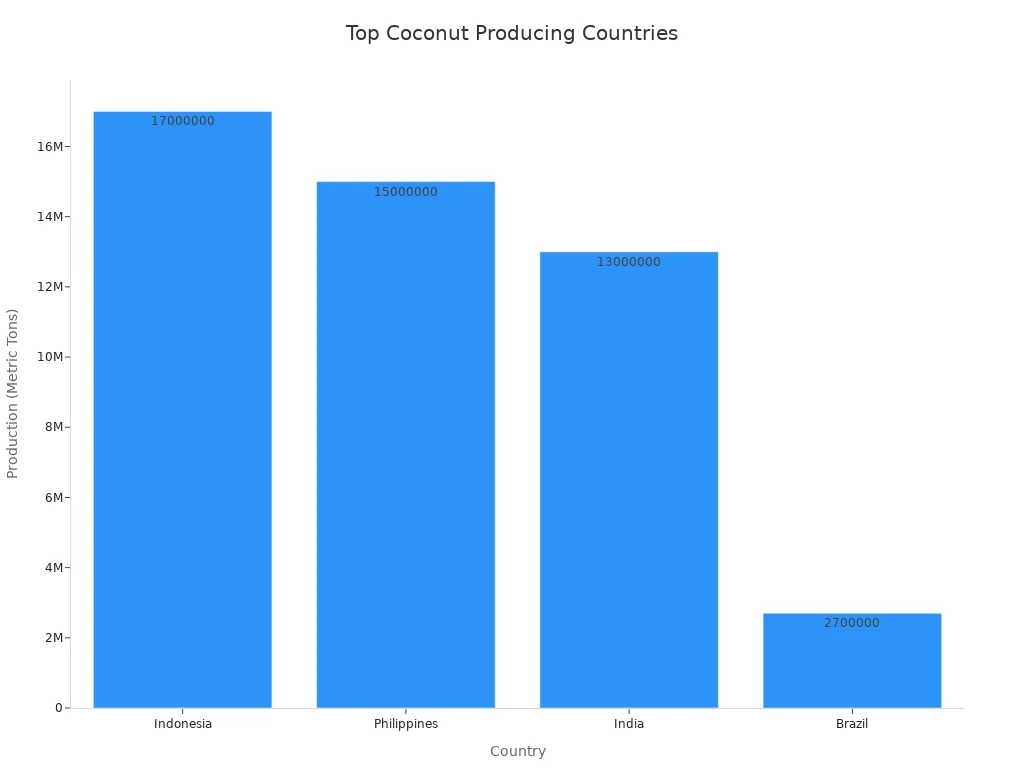
This versatile fruit supports economies and provides countless products. You use coconut for:
Coconut oil
Copra meal
Desiccated coconut
Coir products
Coconut water
Virgin coconut oil
Coconut milk
Cream
You may not know the surprising diversity within types of coconuts, which appear green, orange, or brown depending on ripeness. This guide explores various varieties and provides a comprehensive growing guide. Understanding these varieties helps you choose the right one for your specific uses and ensures successful cultivation.
Key Takeaways
Coconuts come in many types, like tall, dwarf, and hybrid. Each type has different features and uses.
Tall coconuts grow very high and are good for oil. Dwarf coconuts start making fruit sooner and are good for drinking.
Coconut trees need warm weather, lots of sun, and good soil to grow well.
You must protect coconut trees from cold weather and pests. This helps them stay healthy and make many fruits.
Exploring Coconut Varieties

You can broadly categorize the many types of coconuts based on their growth habit: “Tall” (scientifically known as Cocos nucifera var. typica) and “Dwarf” (Cocos nucifera var. nana). These palms are monoecious, meaning they carry both male and female flowers on the same plant, allowing for self-pollination. Understanding these main categories helps you choose the right coconut for your needs.
Tall Coconut Palms
Tall coconut palms are majestic trees. They feature smooth, grayish-brown trunks and can grow over 80 to 100 feet tall. Their leaves can reach an impressive 18 feet long and a foot wide. Some tall varieties have straight trunks, but others, like the ‘Jamaican Tall’ (also called ‘Atlantic Tall’), have crooked trunks and swollen bases. These palms typically start flowering after four to six years, producing small, yellow flowers on branchlets.
For example, the Maypan Coconut Palm is a tall variety. It usually grows 40 to 60 feet high. It has a slender trunk and a graceful crown of fronds. This palm also resists high winds and lethal yellowing disease very well. Another impressive tall variety is the Panama Tall Coconut Palm. It can reach heights of up to 100 feet. You will notice its slender, sky-reaching trunk and lush, feather-like fronds. Its crown has pinnate leaves that can extend up to 20 feet. The coconuts from this palm are large and round. They have a tough, fibrous husk, sweet water, and edible flesh.
Dwarf Coconut Palms
The term “dwarf” for these coconuts refers to the size at which the palm begins to produce coconuts, not its final mature height. Dwarf coconut palms can still grow quite tall, ranging from 50 to 100 feet. The Malayan Dwarf is a well-known variety. It resists Lethal Yellowing disease. You can classify Malayan Dwarf varieties by their nut color: ivory yellow, apricot red, and green. The Dwarf Malayan Coconut is a smaller option compared to larger coconut varieties. It typically reaches a height of 25 feet with a spread of 8-10 feet. These palms can provide fruit perfect for beverages like piña coladas.
Hybrid Coconut Palms
Hybrid coconut varieties result from crossing different species. This process enhances specific characteristics. They combine the high productivity of dwarf varieties with the robustness of tall varieties. You gain advantages like improved productivity, disease resistance, and better adaptation to various environments.
Feature | Hybrid Coconut | Pure Tall Varieties | Pure Dwarf Varieties |
|---|---|---|---|
Flowering/Production Start | 2-4 years | 5-9 years | N/A |
Kernel/Copra/Oil Content | More (from Tall parent) | N/A | N/A |
Bunches/Fruits per Tree | More (from Dwarf parent) | N/A | More |
Life Span | 40-50 years | Up to 100 years | 25-30 years |
Self-Pollination | 40-60% (enhances yield) | N/A | N/A |
Disease/Drought Tolerance | Tolerant/Resistant (from Tall parent) | N/A | N/A |
Yield (Fruits per tree) | 350-700 | N/A | N/A |
As you can see, hybrid varieties offer a balanced approach, often providing the best of both worlds.
Coconuts by Primary Use
Different types of coconuts serve different primary purposes. If you want coconut water, you should look for dwarf-green coconut varieties. People primarily cultivate these for drinking. Tall varieties, on the other hand, are more commonly used for coconut oil and other manufactured products.
For coconut oil extraction, you will find several suitable varieties. Historically, people extract coconut oil from dried coconut meat, called copra. This means varieties grown for copra also work for oil. The Dau Coconut variety is a prime choice for oil extraction because of its high oil content. Researchers have also evaluated other varieties for virgin coconut oil (VCO) production. These include traditional varieties like Bodiri and Red dwarf, and hybrid varieties such as CRISL-2013, CRISL-2014, and CRISL-2020. All these varieties, except Green dwarf, are good sources for producing high-quality VCO.
Distinct Characteristics of Coconut Types
You will find many distinct types of coconuts, each with unique features. These differences make certain varieties better for specific uses. Understanding these characteristics helps you choose the right palm for your garden or farm.
Malayan Dwarf Coconut
The Malayan Dwarf coconut is a globally common variety. You can find it in green, gold, or yellow colors. Green and yellow varieties typically yield more coconut water. Gold varieties produce more meat. This semi-dwarf palm can reach heights of 30 to 60 feet. It grows about 1 to 3 feet each year. It has a narrow trunk, many feathery fronds, and a canopy spread of 15 to 25 feet. The petioles, or leaf stalks, can be green, golden, or yellow. This depends on the specific sub-cultivar.
Despite its “dwarf” name, which refers to its early fruit production, it is smaller than taller types like the Panama Tall and Jamaican Tall. This variety starts producing coconuts at 3-4 years old. It can also start when it has 2-3 feet of grey wood. This is faster than some other cultivars. You will get coconuts year-round, but the yield changes with the seasons. For sweet coconut water, harvest green and smooth coconuts 6-7 months after flowering. For coconut meat, harvest brown and wrinkly coconuts 11-12 months after flowering. This variety yields about 250 nuts per year. It has a lifespan of 60 years. It also shows good drought tolerance and pest resistance. People primarily use it for tender coconut. It starts yielding from 2.5 years.
King Coconut
The King coconut is native to Sri Lanka. People call it “Thæmbili” in Sinhala. This type of coconut has less sugar content compared to other coconuts. King coconut trees are generally shorter than other coconut trees. You can find sub-varieties like “red dwarf” (kaha thæmbili or gon thæmbili) and “Ran Thæmbili,” a smaller variety with about forty nuts per bunch. The liquid endosperm of young King coconut is rich in sugars, mainly reducing sugars. It also contains minerals, mainly K+, vitamins (B & C), and amino acids. This makes it a nutritious beverage.
King coconut water has a bright orange shell. This makes it distinct from the green or brown exterior of regular coconuts. Its water is naturally sweeter and more delicate than other coconut varieties. This makes it a popular hydrating drink. It is rich in essential vitamins, minerals, and electrolytes. This contributes to its reputation as a health-boosting superfood. It also has a higher electrolyte concentration than regular coconut water. This makes it better for rehydration. It has a thinner layer of meat. People primarily harvest it for its water, with less flesh compared to green coconuts. People use King coconut water in Ayurveda, a traditional herbal medicine. A common use involves mixing Aralu powder (Myrobalans) with the water of a King coconut. You will find it as a common daily drink in Sri Lanka, especially in hot weather. It also plays a significant role in Sri Lankan religious and cultural practices. You can enjoy King Coconut Ice Cream, a popular dairy-free dessert. You can also make a King Coconut Milkshake, a nourishing and hydrating beverage. It is also used in cocktails or mocktails and even homemade fermented wine.
West Coast Tall Coconut
The West Coast Tall coconut is a cultivar grown along the west coast of India. It is a high yielder if you manage it well. You can grow it in various agroclimatic conditions and soil types. It takes 7 to 9 years to yield fruit under favorable conditions. This palm can reach a height of up to 80 feet. Its fruit color varies from green to greenish-yellow to different shades of brown. The fruit shape varies from oval to oblong. You can expect an average yield of 80 nuts per palm per year. Each nut contains about 176 grams of copra, with a range of 135-200 grams. The oil content is 68 percent. You can use it for household purposes like copra, coconut oil, and kitchen use. It also yields good quality and quantity of toddy. This variety can grow up to 100 feet tall. It begins fruiting at 6 or 7 years of age. It is somewhat drought-tolerant. It can survive occasional prolonged periods of dry soil. However, it performs best with frequent irrigation. It produces about 80 coconuts per tree each year. Its fruits tend to be larger than those of the East Coast Tall Coconut tree. It also has marginally higher oil content compared to the East Coast Tall.
East Coast Tall Coconut
The East Coast Tall coconut is another prominent tall variety. It shares many characteristics with its West Coast counterpart. You will find it growing along the eastern coast. Like other tall varieties, it typically bears fruit within 6-8 years. This variety is also valued for its robust growth and consistent yield.
Maypan Hybrid Coconut
The Maypan Hybrid coconut is a crossbred variety. It comes from the Malayan Dwarf and Panama Tall varietals. Its key benefits include a notable capacity to resist lethal yellowing disease. It also shows remarkable versatility. This allows it to thrive in diverse climates and soil types. You just need to ensure they are well-drained and environmental conditions are favorable.
Fiji Dwarf Coconut
The Fiji Dwarf coconut, also known as Niu Leka-type Dwarf, has a short, thick stem and wide leaflets. This compact dwarf type is rarer than other varieties. You will find this type of dwarf coconut primarily in the Pacific region. It is a dwarf palm tree. It eventually reaches 30-50 feet tall with a 15-25 foot canopy spread. However, it grows very slowly. It is often only 10-15 feet tall after 20-30 years. It features a thick, crooked trunk and a very tight canopy with broad leaves. It shows strong resistance to hurricane and storm damage. This is due to its thicker trunk and tighter canopy. Its petioles can be bronze or green, depending on the sub-cultivar. Pure Fiji Dwarfs have very tight leaflets on palm fronds. Their growth rings on the trunk are tight, only centimeters apart. They also have a compact, tight branching canopy.
Fruit production typically begins when the palm is 3-4 years old. It can also start when it has 0.5-2 feet of grey wood. The coconuts are smooth and either green or bronze. This depends on the sub-cultivar. They are known for incredibly sweet water when you harvest them perfectly. For meat production, Fiji Dwarf bears large fruit. You should harvest it 11-12 months after flowering. At this point, it appears brown and wrinkly. The Fiji Dwarf is prized for its heavy, dense crown of short, dark leaves. Ornamental growers, landscapers, and gardeners highly seek it. In Florida, it is free of the nutritional deficiencies that affect most other coconuts grown in the region’s less fertile soils. However, its lethal yellowing (LY) resistance can vary.
Exotic Coconut Varieties
You can also find many exotic varieties of coconut trees. These are highly demanded for their unique traits. Chennangi and Sylon are two examples of premium coconut varieties. Other notable types of coconuts include hybrid varieties developed for specific advantages:
Variety | Parentage | Key Attributes |
|---|---|---|
MAWA | Malayan Dwarf x West African Tall | Early bearing, large fruit, copra yield, high nut production (initially) |
MATAG | Malayan Dwarf x Tagnanan Tall | 18% increased copra yield, easy dehusking for dry nuts, large nut size, thinner husk, high water content, superior to MAWA |
Kapruwana | San Ramon x Sri Lankan Green Dwarf (SLGD) | Large fruit trait, high number of fruits, increased copra yield |
These exotic varieties offer specialized benefits. They are often tailored for improved yield, disease resistance, or specific product qualities.
Essential Coconut Growing Conditions

You need specific conditions for your coconut palms to thrive. Understanding these needs helps you grow healthy, productive trees.
Climate and Temperature Needs
Coconut palms love warm weather. The optimal temperature for growth and fruit production of these trees is between 27 to 32 °C. For ideal growth and fruit yield, temperatures should stay within this range. You also want a diurnal variation equal to or less than 7 °C in humid environments. Coconut palm trees cannot tolerate frost. They prefer a minimum temperature of around 72°F (22°C) to flourish. For their true potential, temperatures should ideally remain above 72°F (22°C) all year. Even short exposure to frost can cause significant damage to your coconut tree.
Soil and Drainage
The right soil is crucial for your coconut palm. Coconut palms thrive in slightly acidic to neutral soils. An ideal pH range is 5.5 to 7.5. pH levels outside this range can stop your palm from absorbing nutrients and growing well. Proper drainage is also very important. It prevents waterlogging, which can lead to root rot and other diseases. Good drainage keeps the palm’s root system healthy. While good drainage is essential, the soil must also hold enough moisture. This provides a steady water supply for the palms, especially during dry times.
Sunlight Requirements
Coconut palms are sun-loving plants. You must provide them with plenty of direct sunlight. They need at least six to eight hours of full sun each day. This ensures strong growth and good fruit development. Without enough light, your coconut palm may not produce as many fruits.
Water and Humidity
Water and humidity are vital for your coconut palm. Mature green coconut palms require 15-30 gallons of water daily for optimal fruit yield. You should ensure the soil remains damp but not waterlogged. These palms thrive in high humidity. Ideally, you should maintain humidity between 70% and 80%. For potted coconut palms, high humidity, preferably around 70%, is a crucial element.
Planting Your Coconut
Planting your own coconut palm is a rewarding experience. You need to understand the steps from seed selection to initial care. Young coconut trees generally require six to ten years before producing fruit. Some dwarf varieties are much faster.
Seed Selection
You start by choosing the right seed. Select nuts from high-yielding mother palms. These palms produce at least 100 nuts per year under irrigation or 70-80 nuts under rain-fed conditions. Each husked nut should weigh at least 600g, and the copra content should be 150g or more. Ensure your seed nuts are free from pests and diseases. Avoid palms older than 60 years or those with long, thin, pendulous flower stalks. Do not pick nuts from palms that produce long, narrow, small, or barren nuts. Also, avoid palms that shed many immature nuts. Harvest mature nuts when at least one nut in the oldest bunch starts to dry. You will hear a resonant, ringing sound when you tap it. Medium-sized, round, or oblong nuts are best. Air-cure tall and hybrid seed nuts for one month, then sand-cure them for two months. Dwarf varieties need less than one month of air-curing before two months of sand-curing.
Sprouting Process
You can sprout your coconut seed with these steps:
Ensure the coconut is fresh, uncracked, intact, and full of water.
Place stones over the coconut in a bucket. Fill it with water and soak it for 3-4 days in a warm, sunny spot. This starts germination.
After soaking, plant the coconut in a pot with rich potting soil.
Before planting, float the coconut in water to find its natural orientation. Plant it in the same position, burying one-third of it in the soil.
Put the potted coconut in a sunny, humid place. Water it daily, but do not overwater to prevent rot. Optimal germination happens in full sun for over 10 hours a day at temperatures above 90°F.
Transplanting Seedlings
Transplant your coconut seedlings at the right time. The best age for transplanting is 6-8 months. At this age, the plant has a good root system, and you reduce planting shock. The youngest leaves should also show differentiation into leaflets. For Dwarf x Tall hybrid plants, look for a collar circumference of 18-20 cm, 7 to 8 living leaves, and a height of 110 to 120 cm. You can extend the transplanting window to 5-12 months in areas with limited rainfall.
Initial Care for Young Palms
After transplanting, care for your young coconut palm. Young coconut trees typically begin producing fruit within 5-6 years in good soil. However, they more commonly start yielding fruit around 7-9 years. They reach their full bearing capacity after 12-13 years. Be patient; your efforts will eventually lead to delicious coconuts.
Caring for Coconut Palms
You must care for your coconut palms to ensure they stay healthy and produce many fruits. This involves proper feeding, trimming, pest management, and knowing when to pick your coconuts.
Fertilization
Coconut palms need regular feeding to grow strong. You should use a fertilizer made for palms. These fertilizers often contain a good balance of nitrogen (N), phosphorus (P), and potassium (K). They also include important micronutrients like magnesium, manganese, and boron. You can apply fertilizer every three to four months. Always follow the instructions on the fertilizer package. This helps prevent over-fertilization, which can harm your palm. A well-fed coconut palm resists diseases better and gives you more fruit.
Pruning
Pruning your coconut palm helps it stay healthy and look good. You should avoid “hurricane cutting” or “hurricane pruning.” This practice severely damages the palm tree. Only remove fronds that are completely brown and hang below the 3 o’clock or 9 o’clock position. The main goal of pruning is to remove only dead growth. If you hire a professional, tell them you want a rounded canopy, not a “mohawk” style.
Note: If your palm has a potassium (K) deficiency, only remove completely dead leaves. Older leaves with K deficiency still provide potassium to the palm. If you have corrected K deficiencies, you can safely remove green leaves from the bottom of the canopy. This will not affect the palm’s nutritional status. ANSI pruning standards for palms say you should not remove leaves with tips above the horizontal plane (9:00 and 3:00 positions). This is especially true if K deficiency is present or not corrected.
You can also prune developing flowers and fruit stalks. This helps manage litter and saves the tree’s energy. For self-cleaning palms like the coconut, you should still check for any dead fronds or flower stalks. This is important for safety. Before you cut, look at the tree. Find dead, unhealthy, or browning fronds. Also, find any flower or fruit stalks you need to remove. Place your tool at the base of the frond near the trunk. Do not cut too close to the trunk. This prevents injury, diseases, or pests. Make smooth, clean cuts. This helps the palm heal quickly and reduces the chance of infections.
Never cut into the trunk with a machete. This creates wounds that can lead to Thielaviopsis trunk rot. Do not pull off leaves that do not come off easily. This can tear trunk tissue. It also creates wounds that are open to Thielaviopsis trunk rot. Never use climbing spikes for pruning palm leaves. The wounds will not heal. They can become entry points for diseases or attract pests like palm weevils. Removing living flower or fruit stalks does not harm palms. It can even increase leaf production rates. Removing flower stalks stops messy fruit drop. It also prevents unwanted seedlings from sprouting. In public areas, removing small flower stalks is easier and safer. It is better than dealing with heavy clusters of coconut fruit, which can be a safety risk.
Pest and Disease Control
Coconut palms can face various pests and diseases. You must identify and control them early.
Pest | Symptoms | Management Methods |
|---|---|---|
Black headed caterpillar (Opisina arenosella) | Feeds on leaves, causing damage. | Release natural enemies like parasitoids and predators. Remove and burn affected leaves. Spray Malathion 50 EC 0.05% for severe outbreaks in young palms. |
Red palm weevil (Rhynchophorus ferrugineus) | Wilting and yellowing fronds, palm collapse, fermented smell, oozing fluid, chewing sounds. | Remove and burn wilting or damaged palms. Avoid stem injuries. Fill holes with cement. Cut green leaves 120 cm from the stem. Set up attractant traps. Use root feeding. Destroy infested palms. Use pheromone and sticky traps. Systemic insecticides can be a last resort. |
Termites (Odontotermes obesus) | Damage to the trunk and roots. | Find and destroy termite mounds. Swab the trunk base (up to 2m) with neem oil 5%. Spray Copper sulphate 1%, Cashew nut shell oil 80%, or NSKE 20% to protect planted leaves. |
Scale insect (Aspidiotus destructor) | Yellowing and premature leaf drop, reduced vigor. | Do not harvest nuts for 45 days after spraying. Use parasitic wasps. Apply horticultural oils during dormant periods. Monitor and prune infested areas. |
Mealy bugs (Pseudococcus longispinus) | White, cottony masses, stunted growth, honeydew leading to sooty mold. | Remove and destroy infested leaflets. Spray Malathion 50 EC 2 ml/lit, Dimethoate 30 EC 1 ml/lit, Methyl demeton 25 EC 1 ml/lit, Phosphamidon 40 SL 1.25 ml/lit, Methomyl 25 EC 1 ml/lit, or Neem oil 3%. Release ladybugs. Apply horticultural oils or insecticidal soaps. Maintain plant health. |
Leaf caterpillars (Turnaca acuta) | Damage to leaves. | Collect and destroy immature stages. Spray Carbaryl 0.1%. |
Coconut Rhinoceros Beetle (Oryctes rhinoceros) | Large holes in leaf bases, chewed leaves, damaged growing points. | Manually remove larvae and adults. Use pheromone traps. Use biological control with Oryctes rhinoceros nudivirus (OrNV). |
Coconut Leaf Beetle (Brontispa longissima) | Brown streaks on leaves, dried and distorted young leaves. | Introduce parasitoid wasps. Prune and destroy infested leaves. Use neem-based insecticides. |
The Red Palm Weevil is a very damaging pest. It feeds on the soft tissues inside the palm. Signs of infestation include wilting and yellowing fronds. The palm may collapse. You might smell a fermented odor from feeding galleries. You may also see oozing fluid or hear chewing sounds. Control involves early detection and regular monitoring. Destroy infested palms. Use pheromone traps. Natural predators or pathogens can help. Chemical treatments are a last resort. Preventative steps include avoiding palm injuries and keeping the plantation clean. The Rhinoceros Beetle attacks young palms. It bores into the crown. This leads to V-shaped cuts or holes in new leaves. You can control it with pheromone traps for adult beetles. Keep the plantation clean by removing breeding sites like decaying logs. Biological control using natural predators or fungi also helps.
Harvesting
Knowing when to harvest your coconut is key. The best time depends on what you want to use the coconut for. For maximum copra and oil recovery, the estimated age of maturity is 11 to 12 months from pollination.
Here are signs that a coconut is ready for harvest:
The husk shrinks.
The skin color changes. It becomes a dry brown at 12 months. The calyx keeps its fresh color (green, bronze, red, or yellow).
You hear and feel a splashing sound when you shake the nut. This means some water has been absorbed. It creates an air space inside.
The husk color is the main sign. Nuts will be partially or completely brown.
Mature and over-mature fruits make a “hollow” sound when you tap them. Immature fruit makes a “solid” sound.
The flesh thickness is a key physical trait to tell different maturities apart.
The specific gravity decreases as the coconut matures. It goes from 1.105 to 0.890 during the immature period. It drops further to 0.854 by the end of the mature period.
You can harvest coconuts by climbing the tree or using a long pole with a blade. Always be careful when harvesting.
Overcoming Coconut Growing Challenges
You may face some challenges when growing coconut palms. Knowing how to handle these issues helps ensure your trees stay healthy and productive.
Cold Weather Protection
Coconut palms thrive in warm climates. Cold weather can severely damage them. You must protect your coconut from freezing temperatures. To protect palms sensitive to cold, especially the vital young spear leaf, wrap the palm leaves together. Then, wrap them in frost cloth. Damage to the spear leaf, which is the growing tip, can kill your palm.
You can also take other steps. Cinch up the fronds with a rope. This reduces the palm’s girth and protects inner fronds. Use a 1-inch PVC pipe, long enough to extend over the highest frond. Tie it to the palm to support the weight of insulation. Wrap the palm with a flannel sheet. Then, wrap heating cables over the sheet. Wrap the entire palm with a good insulated material, such as a quilted mattress cover. Ensure multiple layers for higher R-value insulation.
Water the roots thoroughly. Apply a thick layer of organic mulch to the root zone before cold weather arrives. This mulch should be 1.5 to 3 times the canopy width. Mulch helps moderate soil temperature. It also re-radiates warmth. For sensitive plants, cover them with materials like cloth sheets or blankets.
You can also use plastic. Ensure the cover does not touch the leaves. It should extend to the ground. A frame can keep the cover off the foliage. Consider placing a heat source, like a light bulb, inside the covered structure on frigid nights. This provides additional protection. Remove covers in the morning as temperatures rise. This prevents heat buildup and potential plant damage. Routine application of a complete landscape palm fertilizer (e.g., 8N-2P2O5-12K2O-4Mg) also helps. It prevents cold-induced deficiencies. It enhances the palm’s cold hardiness. Fertilization improves cold tolerance in your coconut.
Nutrient Deficiencies
Your coconut palm needs proper nutrients to grow well. You can spot nutrient deficiencies by looking at the leaves.
Boron (B): You may see premature fruit abortion. Inflorescences near the tips might look necrotic. Fallen coconuts lack a blackened calyx end. This helps distinguish it from lethal yellowing.
Potassium (K): Look for translucent yellow or orange spotting on leaflets. This can progress to marginal and tip necrosis. Later stages show small chlorotic and necrotic new leaves. The trunk may also taper.
Manganese (Mn): Necrotic leaflet tips fall off. This gives the leaf a singed appearance. In severe cases, growth stops. New leaves may be petiole stubs. Meristem death can occur.
Common Pests and Solutions
Coconut palms can suffer from various pests and diseases. You must manage these problems effectively. Prevalent diseases include Bud rot, Root wilt, Leaf spot diseases, Stem bleeding disease, and Lethal yellowing.
You can use Integrated Disease Management strategies. Choose proper sites with well-draining locations. Ensure adequate spacing and air circulation. Promptly remove and destroy infected plant material. This is called sanitation.
Manage water properly. Ensure good drainage and avoid overhead watering. For prevention, regularly apply copper-based fungicides. Use Bordeaux mixture on the crown and trunk. Systemic fungicides work for high-value palms. You can also use biological control options. Apply beneficial microorganisms like Trichoderma species. Use organic amendments to improve soil health. Early detection is key. Regularly walk through your plantation to observe your coconut trees. Keep detailed records of symptoms and treatments. Train workers to recognize early symptoms. Investing in prevention is cost-effective. Plan for replacement with disease-resistant varieties. Adapt strategies to changing rainfall, storms, and temperatures. Develop contingency plans for post-storm disease management.
You have explored many coconut varieties, each with unique attributes. There is a perfect coconut for every need. Growing your own coconuts is feasible and rewarding with proper care. Remember, patience is key for fruit production. Choose the right varieties for your climate and intended use. Consider factors like fruiting time and yield. Cultivating this versatile plant brings you joy and many benefits. You can enjoy your own fresh coconut.
FAQ
How long until my coconut tree produces fruit?
Young coconut trees usually take 6 to 10 years to bear fruit. Some dwarf varieties are much faster. They can start producing in as little as 2 to 4 years. Patience is key for your first harvest.
What is the main difference between tall and dwarf coconut palms?
Tall palms grow very high. They start fruiting later, around 6-8 years. Dwarf palms begin fruiting earlier, sometimes in 2-4 years. The “dwarf” name refers to early fruiting, not always final height.
Can I grow a coconut tree if I live in a cold area?
Coconut palms need warm climates. They cannot tolerate frost. You must protect them from cold temperatures. Use insulation and other methods to keep them warm. Even short cold exposure can harm your palm.
Which coconut type is best for drinking water?
Dwarf green coconut varieties are best for drinking water. They yield more water. King coconuts also offer sweet, hydrating water. You harvest them when they are young and green.