Many people confuse the coast redwood and the sequoia tree. Both are towering giants and colossal conifers, yet they are distinct species. These magnificent redwoods and sequoias rank among the largest living organism on Earth. This blog demystifies these incredible trees, highlighting the unique characteristics of the giant redwoods, the giant sequoia, and the majestic giant sequoias. We compare each redwood and sequoia to reveal their shared grandeur and the distinct features of every redwood.
Key Takeaways
Redwood and sequoia trees are both giant conifers. They belong to the same plant family.
Coast redwoods are the world’s tallest trees. They grow near the Pacific Ocean.
Giant sequoias are the world’s most massive trees. They grow in California’s Sierra Nevada mountains.
Redwoods have thin, flat leaves. Sequoias have unique cones that need fire to open.
Both types of trees live for thousands of years. They are important for their ecosystems.
Are They The Same? Family Tree
The Conifer Connection
Many people often confuse the giant redwood and the giant sequoia. They are not identical trees, but they certainly share a very close family connection. Both of these impressive trees belong to the conifer group. Conifers are a specific type of plant that produces cones and typically features needle-like or scale-like leaves. This broad botanical group includes many familiar trees, such as pines, firs, and spruces. The majestic coast redwood and the towering giant sequoia both fall under the Cupressaceae family, which people also commonly call the cypress family. Within this larger family, they share the same subfamily, Sequoioideae. This shared lineage clearly demonstrates their deep evolutionary relationship and explains why they exhibit similar characteristics in some aspects.
Distinct Genera
Despite their shared family and subfamily, these magnificent trees actually belong to different genera. A genus represents a classification rank that sits above species but below family. For instance, the Coast Redwood carries the scientific name Sequoia sempervirens. It stands as the only living species within its genus, Sequoia. This specific classification highlights its unique position among its botanical relatives. This particular redwood is truly one of a kind.
Rank | Classification |
|---|---|
Kingdom | Plantae |
Clade | Tracheophytes |
Clade | Gymnospermae |
Division | Pinophyta |
Class | Pinopsida |
Order | Cupressales |
Family | Cupressaceae |
Subfamily | Sequoioideae |
Genus | Sequoia |
The Giant Sequoia, on the other hand, belongs to a completely different genus. Its scientific name is Sequoiadendron giganteum. This particular tree is the only living species found in the genus Sequoiadendron. This distinction means that while they are botanical cousins, they are not direct siblings. This impressive sequoia showcases unique features.
Kingdom: Plantae
Clade: Tracheophytes
Clade: Gymnospermae
Division: Pinophyta
Class: Pinopsida
Order: Cupressales
Family: Cupressaceae
Subfamily: Sequoioideae
Genus: Sequoiadendron
Type species: Sequoiadendron giganteum
This clear distinction in genera means each tree possesses unique characteristics, even with their shared ancestry. A redwood is distinct from a giant sequoia in several important ways, which we will explore further in upcoming sections. This mighty sequoia stands tall.
Habitats and Distribution

These magnificent trees thrive in very specific environments. Their unique characteristics directly relate to the places they call home.
Giant Redwoods: Coastal Realms
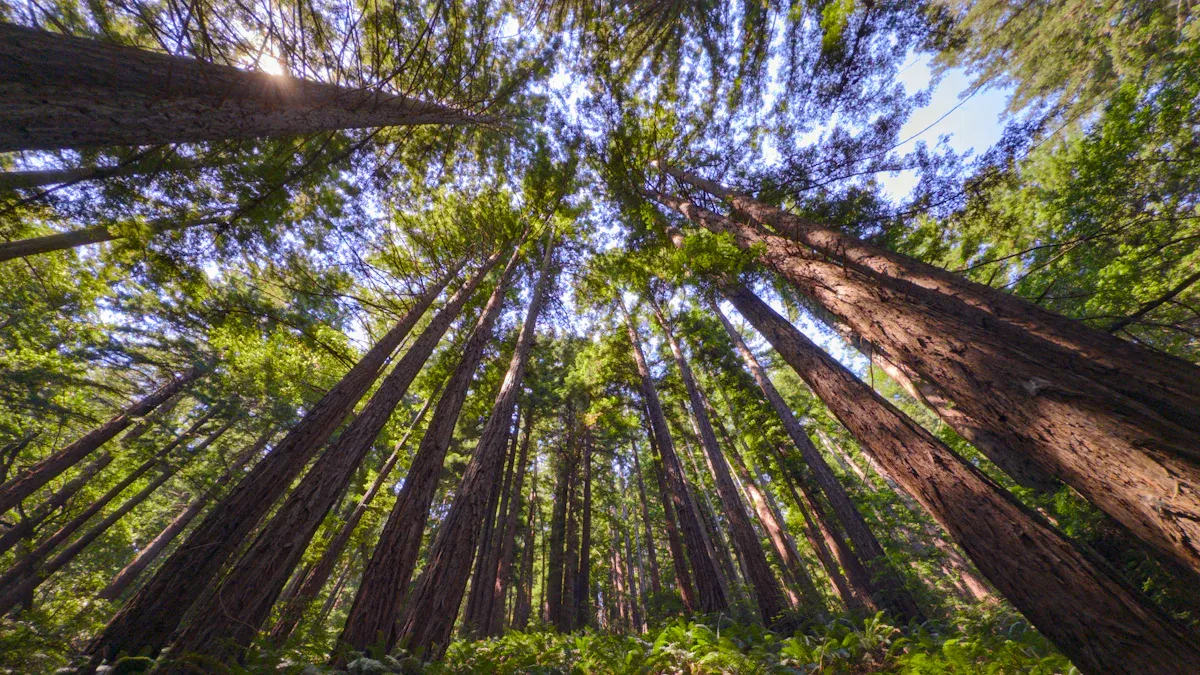
The coast redwood (Sequoia sempervirens) prefers a narrow strip along the Pacific Coast. This region extends from southern Oregon down into Central California. These redwoods typically grow within 50 miles of the Pacific Ocean. They also thrive at elevations less than 2,000 feet. Heavy winter rains and moderate year-round temperatures define these areas. Fog plays a crucial role in their survival. It provides essential moisture during dry summer months. Dense groves of redwood trees are especially common on alluvial flats. These flats sit alongside streams in coastal northern California. Visitors can find many of these towering redwoods in Redwood National Park. This park protects vast areas of these ancient forests. The tallest known living redwood tree, named Hyperion, stands at an impressive 115.55 meters (379.1 feet).
Rank | Name | Height (Meters) | Height (Feet) |
|---|---|---|---|
1 | Hyperion | 115.85 | 380.1 |
A 2004 study suggests the maximum attainable height for a redwood of this species is between 120 to 130 meters. Many other redwoods also reach incredible heights in Redwood National Park. The unique coastal climate allows these giant redwoods to achieve their record-breaking stature. Redwood National Park is a prime example of their preferred habitat.
Giant Sequoias: Mountain Groves
Giant sequoias (Sequoiadendron giganteum) inhabit a different environment. They prefer higher elevations in California’s Sierra Nevada mountains. These sequoias typically grow on the western slopes. Their elevation ranges from 4,000 to 8,000 feet. This mountain habitat provides the specific conditions these massive trees need. A mature sequoia can reach up to 311 feet tall. In their natural wild habitats, these trees can grow up to 350 feet tall. Mature giant sequoias typically have an average height between 164 and 279 feet.
Many groves of giant sequoias exist across this region.
Northern Portion of Giant Sequoia National Monument: This area includes 13 groves in the Hume Lake Ranger District, east of Fresno, California. Sequoia and Kings Canyon National Parks also manage groves here.
Southern Portion of Giant Sequoia National Monument: This part contains 20 giant sequoia groves in the Western Divide Ranger District, east of Porterville and Springville, California. The Monument covers 328,000 acres of the Sequoia National Forest.
Giant Forest: This grove sits on a rolling plateau between the Marble and Middle Forks of the Kaweah River in Sequoia National Park.
Grant Grove: This grove is in Kings Canyon National Park.
Mariposa Grove: This grove is in the southwest corner of Yosemite National Park.
Calaveras Grove: This grove is in Calaveras Big Trees State Park.
These sequoias thrive in these specific mountain conditions. Sequoia National Park protects many of these impressive groves. The distinct mountain climate shapes the growth and distribution of these giant sequoias.
Physical Prowess: Height, Mass, Trunk
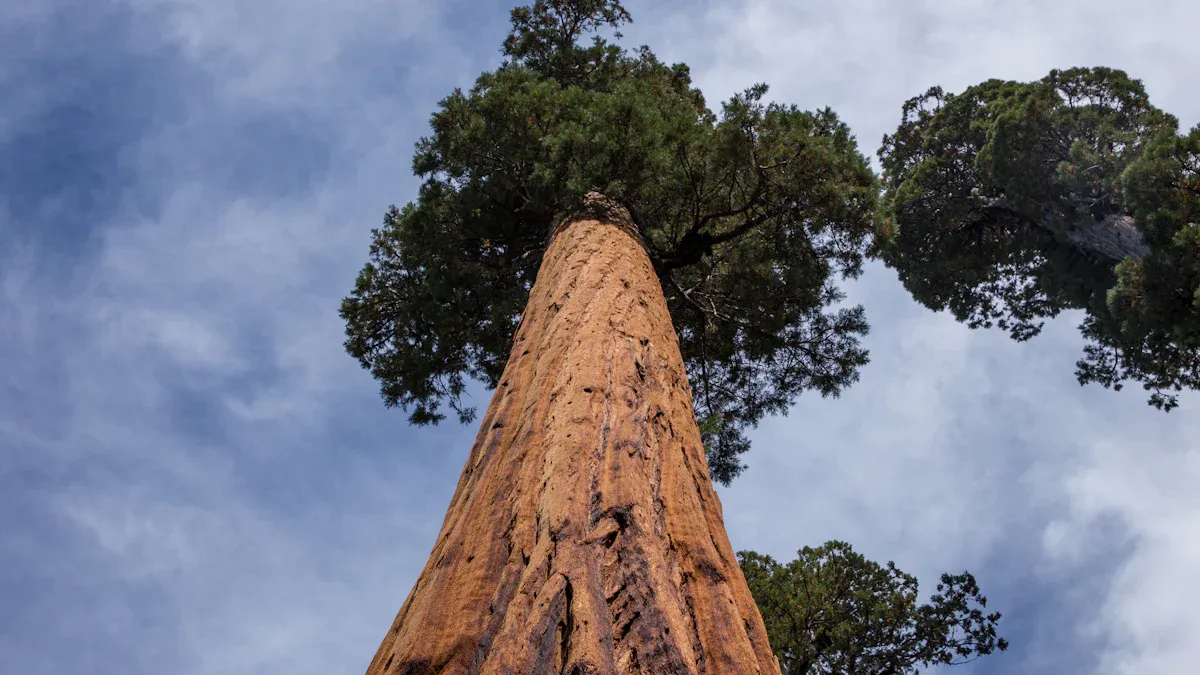
These two colossal conifers display impressive physical differences. One tree reaches higher into the sky. The other boasts an unmatched girth and volume.
Redwood Height: Sky-Scraping Giants
Coast redwoods are generally taller than their sequoia cousins. They hold the record for the world’s tallest trees. These redwoods truly scrape the sky. The redwood named Hyperion stands as the world’s tallest known living tree. It is a coast redwood in California. Measurements in 2019 confirmed its height at 116.07 meters (380.8 ft). Naturalists discovered Hyperion on August 25, 2006. Its initial height was 115.55 meters (379.1 ft). Other notable redwoods like Helios (376 ft) and Icarus (371 ft) also reach incredible heights. Mature Coast Redwood trees typically exhibit an average trunk diameter ranging from 12 to 16 feet. These giant redwoods are truly among the tallest trees on earth.
Sequoia Tree Mass and Girth
Giant sequoias are the most massive trees in the world by volume. They achieve this status due to their exceptionally thick trunks and larger girths. This is true even though they are shorter than redwoods. The General Sherman tree is a famous sequoia. It stands in Sequoia National Park. This sequoia is recognized as the largest living tree by volume on Earth. Its total volume of wood and bark was estimated at 1,591 m³ (56,186 cu ft) in 2013. The main trunk alone contained 1,389 m³ (49,052 cu ft). This makes it the largest tree in the world by volume. Mature Giant Sequoias typically have an average trunk diameter ranging from 20 to 26 feet. The trunks of Giant Sequoias can have diameters between 20 and 26 feet. Some sequoias have diameters over 36 feet at their base. These sequoias are truly the most massive trees.
Bark and Wood Characteristics
The bark and wood of these giants also show distinct features. A redwood has thick and fibrous bark. This bark can grow over 12 inches thick. It features deep vertical grooves. The bark also has a reddish-brown tint and contains hairy strands.
Mature Coast Redwood trees typically exhibit an average trunk diameter ranging from 12 to 16 feet.
The bark of the Giant Sequoia is different. It is reddish-brown, fibrous, very thick, spongy, and deeply furrowed. This bark also has a cork-like texture. The wood texture also varies. Giant sequoias have coarser wood. Redwoods often show wider growth rings. The trunk taper also differs. Sequoias have a lower trunk taper. This means their trunks stay wide for a greater height.
Foliage, Cones, Lifespans
Leaf and Cone Distinctions
The foliage and cones of these colossal trees show clear differences. Coast redwood trees possess two distinct types of leaves. These leaves serve different purposes. They help the redwood adapt to varying wet and dry conditions. The leaves are generally thin, flat, and needle-like. They typically measure up to an inch in length. They also contain stomata, tiny pores vital for photosynthesis and water movement.
Peripheral leaves: These leaves primarily perform photosynthesis. They convert sunlight into sugar. They also have a waxy coating. This coating slows water absorption. It helps them continue photosynthesis during wet periods.
Axial leaves: These leaves specialize in absorbing water. They contribute minimally to photosynthesis. These leaves can absorb a significant amount of water. A large redwood can absorb up to 14 gallons in the first hour of wetness.
Giant sequoia cones also have unique features. These seed cones mature and open in two years. However, they can persist on the tree for up to 20 years. They are oblong with persistent, thick, and woody scales. Each scale contains 3-9 lenticular seeds. These seeds are subequally two-winged. This phenomenon of retaining living green cones with viable seeds for decades has not been observed in any other conifer species. Fire is essential for germination. It clears the forest floor and causes cones to open. This releases the seeds.
Ancient Lifespans
Both the redwoods and sequoias are incredibly long-lived. The average lifespan of a Coast redwood tree typically ranges from 500 to 700 years. Some individuals can live for over 2,000 years. Researchers found one redwood in Redwood National and State Parks to be 2,520 years old. An explorer identified eight Coast redwoods that were at least 3,000 years old. Another Coast redwood, named ‘Deja Vu’, is suspected to be in the 3,000 to 4,000 year range.
Giant sequoias also live for thousands of years. The giant sequoia known as ‘The President’ is approximately 3,200 years old. This makes it the oldest identified sequoia. Other older trees may exist, but this is the maximum recorded age for a specific individual. These ancient trees stand as living testaments to time.
Ecological Roles and Conservation
Ecosystem Impact
These colossal trees play vital roles in their environments. Coast redwood forests provide shelter and nourishment for countless species. They act as guardians of an ecosystem teeming with life. These redwoods support high biodiversity. They are home to thousands of plant and animal species. Every layer supports a unique web of life. For example, the northern spotted owl lives in branches. The banana slug lives on the forest floor. These forests also maintain water and soil health. Their vast canopies capture moisture. This creates fog drip, which is vital for the ecosystem during dry months. Deep roots anchor and stabilize the soil. Redwood forests store more carbon per acre than other forest types. They play a crucial role in climate change mitigation. They contribute to global climate health by capturing carbon and regulating the atmosphere. The brown creeper, a bird species, relies on mature redwood trees for habitat. It spirals up tree trunks to find spiders and other invertebrates in deep bark cavities. Redwood forests are a “fabric of California ecosystems.” They are a “source of rich biodiversity.”
Giant sequoia trees also influence their surroundings. Their litter is rich in base cations like calcium, magnesium, potassium, and sodium. This enrichment increases extractable calcium levels in the upper mineral soil. Giant sequoias indirectly influence microbial communities. They maintain high soil pH and moisture content. Soil bacterial, archaeal, and fungal communities under sequoia trees are distinct from those under sugar pine. Bacterial and archaeal richness is greater beneath giant sequoias. This is possibly due to increased niche space. Giant sequoias associate with arbuscular mycorrhizal fungi (AMF). These fungi are more abundant and diverse beneath them. Other trees associate with ectomycorrhizal fungi (EMF).
Conservation Challenges for Redwoods and Sequoias
Both redwoods and sequoias face significant conservation challenges. Extensive wildfires pose a major threat to giant sequoias. These fires lead to unprecedented mortality of mature sequoia trees. Native bark beetles are also killing sequoia trees. This is a newly reported phenomenon. Widespread sequoia foliage dieback occurred in 2014. This was a short-term response to drought. Over 85% of all giant sequoia grove acreage across the Sierra Nevada burned in wildfires between 2015 and 2021. This is a significant increase compared to only 25% in the preceding century. These fires killed 13% to 19% of the world’s large sequoias. This totals 8,431 to 11,897 trees. Historically, giant redwoods and giant sequoias thrived with low- to moderate-intensity fires. These fires occurred every 8-15 years. They aided reproduction. Their thick bark tolerated these fires. However, over a century of fire suppression policies has led to unnaturally high densities of understory and midstory trees. This, combined with drier conditions and longer fire seasons due to drought and climate change, creates a “tinderbox” effect. This results in severe fires that burn into the canopies of mature sequoia trees and kill them.
Both the coast redwood and sequoia tree are awe-inspiring giants. They possess distinct characteristics. Giant redwoods are known for their incredible height. A sequoia tree boasts immense volume. Their habitats also differ. The redwood thrives in coastal fog. Giant sequoias prefer mountain groves. These giant redwoods and sequoias are truly natural wonders. We must preserve these magnificent redwood and sequoia trees for future generations.
FAQ
What is the primary difference between a redwood and a sequoia?
Coast redwoods are the world’s tallest trees. They hold records for height. Giant sequoias are the world’s most massive trees by volume. They have exceptionally thick trunks. This makes them the largest in terms of sheer bulk.
What specific habitats do coast redwoods prefer?
Coast redwoods thrive in a narrow strip along the Pacific Coast. This area extends from southern Oregon to Central California. They depend on coastal fog for moisture. These trees grow at elevations below 2,000 feet.
What kind of environment do giant sequoias inhabit?
Giant sequoias live in the Sierra Nevada mountains of California. They prefer higher elevations, typically from 4,000 to 8,000 feet. These trees grow on the western slopes. This mountain habitat provides specific conditions for their growth.
What role does fire play in the life cycle of giant sequoias?
Fire is essential for giant sequoia reproduction. It clears the forest floor. Fire also causes their cones to open. This releases seeds for germination. Historically, these trees tolerated low-intensity fires.
What are the typical lifespans of these giant trees?
Coast redwoods typically live 500 to 700 years. Some individuals can live over 2,000 years. Giant sequoias also live for thousands of years. The President sequoia is approximately 3,200 years old.