These five remote-control grow lamps make indoor gardening simple and flexible.
Pick the SunnyBot WiFi model for full-spectrum light, voice control, and fine channel dimming.
Choose a clip-on 56-LED lamp for tight spaces and easy positioning.
Try a SANSI PAR20 screw-in bulb for focused PPFD boosts, a 10 W clip-on for portable precision, or a 35 W wall unit for higher PPFD and sturdy mounting.
| Smart Full-Spectrum LED Grow Light with WiFi |

| Best Smart Pick | Light Spectrum: Full spectrum 380–800 nm (custom blending of yellow/red/blue) | Remote / App Control: Wi‑Fi app control (TUYA) + voice assistants; local offline control | Dimming Levels: 0–100% dimming; 100 levels per color channel | VIEW LATEST PRICE | Read Our Analysis |
| Clip-On Full Spectrum LED Grow Light with Remote |

| Best Flexible Clip-On | Light Spectrum: Multi-spectrum (cool white 6000K, warm white 3000K, red 660 nm, blue 460 nm; selectable modes) | Remote / App Control: Remote control + top-button control | Dimming Levels: 10 brightness levels (dimmable) | VIEW LATEST PRICE | Read Our Analysis |
| SANSI Dimmable Full-Spectrum PAR20 Grow Light Bulb |
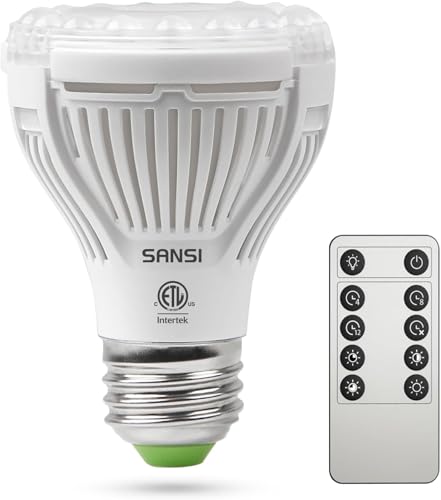
| Best Bulb-Style Option | Light Spectrum: Full spectrum 400–780 nm (4000K; PAR20 focused beam) | Remote / App Control: Remote control for dimming/timer | Dimming Levels: Four brightness levels (25/50/75/100%) | VIEW LATEST PRICE | Read Our Analysis |
| Clip-On Full Spectrum Grow Light with Remote |

| Best Small-Plant Clip | Light Spectrum: Full spectrum 380–800 nm (6000K white, 3000K warm, 660 nm red, 450 nm blue) | Remote / App Control: Remote control + built-in top-button control | Dimming Levels: 10 dimmable levels | VIEW LATEST PRICE | Read Our Analysis |
| SANSI 35W Full-Spectrum Wall-Mounted Grow Light |

| Best For Serious Growers | Light Spectrum: Full spectrum 400–780 nm (4000K daylight; Ra 95+) | Remote / App Control: Remote control with timer and dimming | Dimming Levels: Four brightness levels (25/50/75/100%) | VIEW LATEST PRICE | Read Our Analysis |
More Details on Our Top Picks
Smart Full-Spectrum LED Grow Light with WiFi
Provided you’re caring for houseplants and want hands-off, reliable light that adapts to every growth stage, the SunnyBot Smart Plant Light is a strong choice. You’ll like its French inspired white metal finish and sturdy base that won’t tip. It uses 48 LEDs to deliver a full range from 380 nm to 800 nm, helping seedlings, leaf growth, and flowering. You can fine tune yellow, red, and blue channels with 100 levels each and dim 0 to 100 percent. Connect over WiFi with the TUYA app, use voice control, set smart timers, and extend the height up to 33 inches.
- Light Spectrum:Full spectrum 380–800 nm (custom blending of yellow/red/blue)
- Remote / App Control:Wi‑Fi app control (TUYA) + voice assistants; local offline control
- Dimming Levels:0–100% dimming; 100 levels per color channel
- Timer Function:Smart timer / precise scheduling via app
- Suitable for Indoor Plants:Designed for all indoor plants; full growth cycle support
- Power / Wattage:Typical 10 W (max compatible 15 W); 5 V input
- Additional Feature:French-inspired metal finish
- Additional Feature:Retractable 33″ support rods
- Additional Feature:WiFi + Alexa/Google
Clip-On Full Spectrum LED Grow Light with Remote
Should you want an easy, low-fuss way to keep small houseplants healthy year-round, this clip-on full range LED grow light with remote is often the best choice. You get 56 LEDs mixing cool white, warm white, red, and blue to match growth stages. You can switch among three color modes and fine-tune brightness with ten levels. The remote and top button simplify use, while the memory timer handles 4, 8, or 12-hour cycles. A 360° gooseneck and long wire let you position light through inserting into soil, clamping pots, or attaching to a table. It suits succulents, violets, and office plants.
- Light Spectrum:Multi-spectrum (cool white 6000K, warm white 3000K, red 660 nm, blue 460 nm; selectable modes)
- Remote / App Control:Remote control + top-button control
- Dimming Levels:10 brightness levels (dimmable)
- Timer Function:Auto on/off memory timer (4/8/12-hour cycles)
- Suitable for Indoor Plants:Suited for indoor potted plants, balconies, offices, greenhouses
- Power / Wattage:10 W power (USB powered)
- Additional Feature:360° flexible gooseneck
- Additional Feature:Three fixing methods
- Additional Feature:63″ power cord
SANSI Dimmable Full-Spectrum PAR20 Grow Light Bulb
Should you want simple, reliable grow light control without fuss, the SANSI Dimmable PAR20 is a smart pick for small indoor gardeners and busy plant parents. You’ll get a 10 W LED that feels powerful, giving about 1000 lumens and a 4000 K full range that covers 400 to 780 nm for all growth stages. The ceramic PAR20 with E26 base focuses light with a secondary lens, raising PPFD near seedlings and pots. The included remote sets four dim levels and three timers, so you can tailor brightness and schedule easily. It lasts 25,000 hours and ships with five year protection.
- Light Spectrum:Full spectrum 400–780 nm (4000K; PAR20 focused beam)
- Remote / App Control:Remote control for dimming/timer
- Dimming Levels:Four brightness levels (25/50/75/100%)
- Timer Function:Timer options (4/8/12 hours) with auto on/off
- Suitable for Indoor Plants:Intended for indoor supplemental lighting for potted plants/flowers
- Power / Wattage:10 W (PAR20, 120 V)
- Additional Feature:E26 screw base
- Additional Feature:Secondary optical lens
- Additional Feature:Ceramic construction
Clip-On Full Spectrum Grow Light with Remote
Should you want a simple, powerful grow light that’s built for busy plant lovers and small spaces, this clip-on full-range lamp is a great pick — it’s perfect should you need hands-off control and flexible placement. You’ll like the full range from 380 to 800 nm that mixes 6000K and 3000K whites with 660 nm red and 450 nm blue. It has 56 LEDs, 10 W output, and ten dimmable levels for seedling to bloom needs. You can clip it to shelves, stake it in soil, or bend the 360° gooseneck. Use the top button or remote and set 4, 8, or 12 hour timers.
- Light Spectrum:Full spectrum 380–800 nm (6000K white, 3000K warm, 660 nm red, 450 nm blue)
- Remote / App Control:Remote control + built-in top-button control
- Dimming Levels:10 dimmable levels
- Timer Function:Timer options (4/8/12 hours) with memory
- Suitable for Indoor Plants:Suited for indoor small potted plants (shelves, desks, living rooms)
- Power / Wattage:10 W (USB powered)
- Additional Feature:Strong clip (≤1.90″ thick)
- Additional Feature:Spike soil insertion option
- Additional Feature:USB-powered design
SANSI 35W Full-Spectrum Wall-Mounted Grow Light
Should you want a compact, reliable grow light that feels made for small spaces and busy routines, the SANSI 35W wall-mounted model is a strong pick. You’ll like its full range 400–780 nm and 4000K daylight tone that suits seedlings through full life-cycle growth. It delivers about 180 μmol/s/㎡ at 1 ft and uses through-lens secondary distribution to enhance usable light. You can rotate the head 90° and dim to 25, 50, 75, or 100 percent with the remote and set 4/8/12 hour cycle timers. The chip-on-ceramic design aids cooling, installation is simple, and support includes a two-year warranty.
- Light Spectrum:Full spectrum 400–780 nm (4000K daylight; Ra 95+)
- Remote / App Control:Remote control with timer and dimming
- Dimming Levels:Four brightness levels (25/50/75/100%)
- Timer Function:Cycle timer modes (on 4/8/12 hours; off cycles) via remote
- Suitable for Indoor Plants:Suitable for seedlings, vegetative and full life‑cycle supplemental indoor lighting
- Power / Wattage:35 W power (wall‑mounted unit)
- Additional Feature:Rotating 90° lamp head
- Additional Feature:Chip-on-ceramic tech
- Additional Feature:2-year warranty
Factors to Consider When Choosing Remote Control Plant Growing Lamps
At the time you pick a remote control plant growing lamp, contemplate about the light range and how it matches your plants stage so they’ll get the right colors for growth. Also check the output and PPFD ratings, plus whether the dimming, timer, and scheduling features give you the control you need for steady light cycles. Finally, consider mounting options and flexibility because where and how you place the light affects coverage and plant health.
Light Spectrum Needs
Picking the right light range matters a lot for your plants, because different colors do different jobs and you want a lamp that matches each growth stage. You’ll want blue light around 430 to 460 nm to keep seedlings compact and healthy. Then shift toward red around 640 to 670 nm whenever you want flowering and fruiting. Lamps that blend both bands support the whole life cycle, while full range 380 to 800 nm fixtures mimic sunlight and help natural shape and pigment. Look for a balance: higher blue for young plants, higher red later. Small amounts of UV-A near 380 to 400 nm and far red around 700 to 780 nm can enhance flowers and canopy penetration, but control doses to avoid stress.
Output And PPFD
Often you’ll look at a lamp’s wattage initially, but wattage only tells you how much electricity the fixture uses, not how much plant-usable light it puts out. You want PPFD because it measures the photons hitting your plants each second in µmol/m²/s. That number predicts growth at a given distance and position. Aim for about 50 to 150 for seedlings, 150 to 400 for vegetative growth, and 400 to 800 or more for flowering and fruiting depending on the plant. Check PPFD at set distances or a full PPFD map across the canopy so you see real coverage. Also watch uniformity and beam angle. High hotspots with poor uniformity make uneven plants. Compare average PPFD and percent uniformity for a steady, healthy canopy.
Dimming And Controls
You’ve already learned how PPFD tells you how much light your plants actually get, and now you’ll want control tools that let you shape that light as the plants grow. You’ll want fine-grained dimming so seedlings aren’t blasted and flowering plants get full power at the moment needed. Look for 0 to 100% range or many stepped levels to match species and stages. Also choose lights with multiple dimmable color channels so you can tweak red blue and white balance for each phase. Check control interfaces too since buttons remotes apps and voice each change convenience and range. Make sure settings persist after power loss and that controls respond quickly and work reliably even without internet. That way you feel confident adjusting light exactly whenever plants need it.
Timer And Scheduling
Once you set up your grow lamp, a reliable timer keeps plants on track so they don’t get confused by sudden light changes. You should pick lights with programmable timers that offer multiple daily cycles, so you can match each species’ natural photoperiod. Look for memory or auto recall functions that restore schedules after power loss to avoid stressing plants. Prefer timers with fine grained dimming and gradual ramp up and ramp down to simulate dawn and dusk and ease intensity shifts. Make sure the timer supports repeating daily cycles plus one off overrides so you can tweak settings for seedlings, vegetative growth, or flowering. Finally confirm the control method fits you, whether on device buttons, remote, or app based Wi‑Fi, so you can adjust without disturbing plants.
Mounting And Flexibility
Getting your grow light mounted right makes a big difference in how well your plants do, so pick a style that fits the space and the plants’ needs. You’ll want a mounting style like clip-on, tabletop base, wall or ceiling mount, or soil spike that matches where you plan to place the lamp and how much weight it carries. Check gooseneck or arm length and maximum extension so you can set the perfect distance for seedlings and mature plants. Make sure clips fit surface thicknesses and that brackets or screws work on your walls. Prefer fixtures with 360 degree articulation or 90 degree rotatable heads so you can shift light across pots. Choose lightweight but sturdy bases or clamps to avoid tipping and slipping.
Power And Efficiency
While you pick a remote control grow lamp, consider about how much usable light the fixture actually delivers and how efficiently it makes that light, because that’s what will affect your plants and your electric bill. You’ll want to compare power-to-PPFD performance rather than wattage via itself because seedlings need very low PPFD and flowering plants need much higher levels. Also check µmol per joule ratings; values above 1.5 to 2.5 show good energy use and lower costs. Look for adjustable output and multiple dim levels so you can save energy and tune intensity as plants change. Good optics and beam angles send more photons to your canopy, so you need less total wattage. Finally, pick fixtures with solid heat management and long rated lifetimes to reduce replacements.
Smart Connectivity Options
You’ve already weighed power and efficiency, and now you’ll want to look at how the lamp connects and communicates, because smart features shape how easy and reliable your daily care will be. First check which wireless options the lamp uses: Wi‑Fi gives cloud access and voice assistant support, Bluetooth lets you control locally, and proprietary RF often limits you to the included remote. Next verify ecosystem compatibility with Alexa, Google Assistant, or HomeKit if you want voice control or to tie the lamp into routines. Look for apps that offer per‑channel dimming and spectrum scheduling so you can match light recipes to growth stages. Also favor devices that store schedules locally and offer encrypted connections plus easy firmware updates to protect your plants and privacy.
Build Quality And Cooling
Because the lamp will run for hours and sit close to plants and people, its build and cooling matter a lot for safety and long life. You’ll want metal or ceramic housings and sturdy clips or bases, since solid materials last longer and move heat away from LEDs. Look for integrated heatsinks, vents, or chip-on-ceramic mounting because these designs lower thermal resistance and keep junction temperatures down. Check the rated operating temperature and claimed LED lifespan, for example 25,000 to 60,000 hours, to judge durability. Prefer passive cooling like large fins and metal bodies whenever you run timers, or active cooling with a small fan for high output units. Also confirm sealed electrical joints, good adapters, and strain-relieved cords to prevent heat-related failures and keep things safe.