

You want a tow-behind aerator spreader that works without drama, and you’ll like three solid choices: Brinly 40″ for durable steel tines, dual seed and aeration use, and a big hopper; Suchtale 40″ for combined spike aeration and broadcast spreading with independent tines for better soil contact; EarthWay T150 for heavy loads, precise side spread control, and tractor or ATV hookup. Each handles medium to large yards, offers sturdy frames and good penetration, and you’ll find details below should you desire more.
| Brinly 40″ Tow-Behind Aerator Spreader (AS2-40BH-P) |
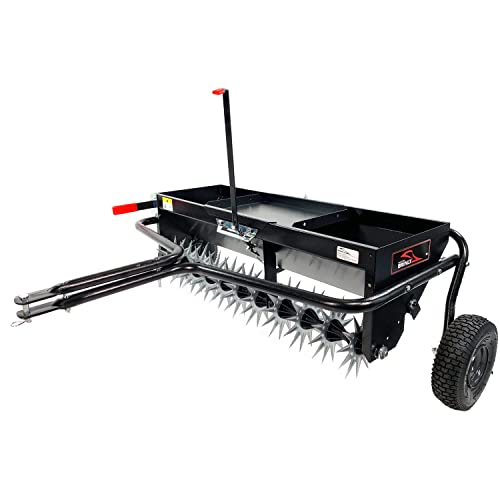
| Best Overall | Tow‑Behind Compatibility: Tow‑behind; fits riders, tractors, most ZTRs, ATVs | Dual Function (Aerate + Spread): Aerator + seed/fertilizer/lime spreader (2‑in‑1) | Steel Construction: Heavy tubular steel tow tube; all‑steel hopper; galvanized steel tines | VIEW LATEST PRICE | Read Our Analysis |
| Suchtale 40″ Tow-Behind Spiker Seeder & Aerator |

| Value Pick | Tow‑Behind Compatibility: Tow‑behind; designed to be pulled by mowers/ATVs/tractors | Dual Function (Aerate + Spread): Spike aerator + broadcast spreader (dual‑function) | Steel Construction: All‑steel hopper and steel frame; high‑grade steel tines | VIEW LATEST PRICE | Read Our Analysis |
| EarthWay T150 150lb Towable Broadcast Spreader |

| Heavy-Duty Capacity | Tow‑Behind Compatibility: Towable; compatible with garden tractors and ATVs | Dual Function (Aerate + Spread): Broadcast spreader (used for seed/fertilizer) and often paired with aeration needs (multi‑use spreader) | Steel Construction: Steel rod calibration; steel components and extended wheelbase | VIEW LATEST PRICE | Read Our Analysis |
More Details on Our Top Picks
Brinly 40″ Tow-Behind Aerator Spreader (AS2-40BH-P)
In case you want a heavy-duty tow-behind that handles big yards without fuss, the Brinly 40″ Tow-Behind Aerator Spreader is built for you. You’ll appreciate the 2-in-1 design that drops seed, fertilizer, or lime while aerating so material reaches the soil fast. The calibrated flow control with adjustable stop keeps spread accurate and lowers waste. You can flip to transport mode and use the single lever to roll on 10 pneumatic wheels. Heavy tubular steel, a 100 lb all-steel hopper, a 75 lb weight tray, and rugged 3-D galvanized tines give lasting strength and easy assembly.
- Tow‑Behind Compatibility:Tow‑behind; fits riders, tractors, most ZTRs, ATVs
- Dual Function (Aerate + Spread):Aerator + seed/fertilizer/lime spreader (2‑in‑1)
- Steel Construction:Heavy tubular steel tow tube; all‑steel hopper; galvanized steel tines
- Adjustable Flow/Control:Calibrated flow control with adjustable stop
- Wheels / Transport Mode:10 pneumatic wheels; transport mode via single lever
- Hopper Capacity / Weight Handling:100 lb (1.74 cu. ft.) hopper; 75 lb weight tray capacity
- Additional Feature:132 tine tips
- Additional Feature:3-D galvanized tines
- Additional Feature:75 lb weight tray
Suchtale 40″ Tow-Behind Spiker Seeder & Aerator
In case you have a medium to large yard and want a tool that saves time while doing two jobs at once, the Suchtale 40″ Tow-Behind Spiker Seeder & Aerator is a great choice. You’ll like how it combines broadcast spreading with spike aeration so seed and fertilizer reach roots faster. The sturdy steel hopper holds over 100 lbs and resists bending, while a high-quality agitator stops clumping. Nine 8 inch 3D steel tines dig about 2 inches, and they rotate independently for better water and nutrient flow. It switches to transport mode easily and maneuvers smoothly, plus expert support helps should you need it.
- Tow‑Behind Compatibility:Tow‑behind; designed to be pulled by mowers/ATVs/tractors
- Dual Function (Aerate + Spread):Spike aerator + broadcast spreader (dual‑function)
- Steel Construction:All‑steel hopper and steel frame; high‑grade steel tines
- Adjustable Flow/Control:Infinitely adjustable flow control plate with indicators and stop device
- Wheels / Transport Mode:8‑inch skid‑resistant rubber wheels; transport mode for smooth movement
- Hopper Capacity / Weight Handling:Over 100 lb hopper capacity (spacious)
- Additional Feature:10-curved-spike tines
- Additional Feature:Infinitely adjustable plate
- Additional Feature:Powder-coated frame
EarthWay T150 150lb Towable Broadcast Spreader
Should you own a garden tractor or an ATV and want a tough tow-behind spreader that makes lawn work easier, the EarthWay T150 is a smart pick. You’ll like its 150 lb capacity for seed, fertilizer, compost, salt, or manure. It hooks to tractors and ATVs, so both homeowners and pros can use it. You’ll control flow precisely with the easy dial and patented Side Spread Control that protects beds and paths. The extended wheelbase and non-skid tires keep it steady while steel rod calibration keeps dispensing accurate. It runs best at 3 mph and includes a one-year warranty.
- Tow‑Behind Compatibility:Towable; compatible with garden tractors and ATVs
- Dual Function (Aerate + Spread):Broadcast spreader (used for seed/fertilizer) and often paired with aeration needs (multi‑use spreader)
- Steel Construction:Steel rod calibration; steel components and extended wheelbase
- Adjustable Flow/Control:Precise flow control with patented side spread adjustment
- Wheels / Transport Mode:Non‑skid tires and extended wheelbase for stability during transport
- Hopper Capacity / Weight Handling:150 lb hopper capacity (large capacity)
- Additional Feature:Patented side-spread control
- Additional Feature:Extended wheelbase
- Additional Feature:1-year limited warranty
Factors to Consider When Choosing Lawn Aerator Spreaders
Whenever you’re selecting an aerator spreader, you want to consider how deep the tines go and whether they’re hollow or solid because that influences soil penetration and recovery. You’ll also care about hopper size and material, spread control accuracy, and whether the unit hooks to a mower or ATV since those determine how much ground you can cover and how easily you operate. Pay attention to general build quality and durability so your investment lasts, and keep these factors in mind as we move into detailed tips on each one.
Aeration Depth And Tine Type
Because your grass needs room to breathe and feed, choosing the right aeration depth and tine type matters a lot. You want tines that reach about 2 inches so air, water, and nutrients can reach roots. Pick steel tines with rust resistant coatings or nylon spacers in case you worry about bending in compacted soil. Also consider tine diameter. Larger assemblies, like 8 inch star or spike tines, make bigger holes and change coverage. More tine tips mean more perforations, so you get better air and moisture flow. Look for independently rotating or staggered tine designs because they penetrate more cleanly and reduce turf damage. Together these choices help you aerate effectively and keep your lawn healthy.
Hopper Capacity And Material
After you pick the right tine depth and type for clean holes and healthy roots, you’ll want to evaluate how much material the spreader can hold and what it’s made of. You’ll appreciate a larger hopper while you’re working on a big yard or helping a neighbor. Bigger hoppers mean fewer refills and more steady progress. Also look at the shape. A wide, easy-fill design reduces spills and lets you pour seed or fertilizer without drama. Material matters too. Steel hoppers stand up to bumps, heavy loads, and weather better than thin plastic, so they won’t bend or rust quickly. Still, good plastics can save weight and resist dents. Reflect on how often you’ll use it and choose a balance of size and durability that feels right for you.
Spread Control Accuracy
How do you make sure every seed and grain of fertilizer lands where it should? You want precise spread control so your lawn gets even coverage without waste. Look for adjustable flow controls with clear indicators so you can match rate to seed size or material. Calibration options like steel rod or plate adjustments let you dial in accuracy and protect flowerbeds and walkways. Stop devices built into the flow control keep material from spilling whenever you pause or turn. Also keep a steady speed as you mow or push, because consistent pace improves accuracy. These features work together: flow settings control volume, stops prevent overrun, calibration fine tunes pattern, and steady speed ties it all into uniform results you can trust.
Tow Compatibility And Hitch
Contemplating whether a spreader will hook up to your mower or ATV without a fuss? You want a hitch that matches your vehicle, whether that means a universal hitch pin or a specific type for a rider, tractor, Zero Turn Mower, or ATV. Check the tow tube design and attachment points so the connection stays secure and reliable while you work. Consider how easy it is to attach and detach, looking for single lever engagement or heavy duty pins that let you hitch quickly. Also confirm the spreader’s size and the vehicle’s weight capacity so stability stays intact and nothing gets strained. Finally, look for machines that shift to transport mode with wheels or other mechanisms to move smoothly once hitched.
Build Quality And Durability
You’ve already checked that the spreader will hook up to your mower or ATV, and now you’ll want to look at how the tool is built so it lasts through seasons of work. Look for heavy tubular steel or powder coated frames. They resist bending and give you confidence whenever you tackle tough soil. Choose galvanized or rust resistant steel tines so corrosion won’t dull them after wet seasons. Solid tine shafts with nylon spacers cut down wear and keep aeration consistent. Pay attention to hopper material and capacity. An all steel hopper resists twisting and handles heavier loads without flexing. Durable wheels, like pneumatic or skid resistant rubber, help you move the unit and keep it working year after year.
Maneuverability And Wheel Design
At the moment you’re pushing an aerator spreader across uneven turf, wheel design becomes one of the initial things you’ll observe and the one that makes the job feel either easy or frustrating. You’ll want pneumatic or rubber wheels because they soak up bumps and keep movement smooth. Larger diameter and wider wheels help you roll over roots, seams, and rough spots without getting hung up. Independent wheel rotation lets you turn tightly around trees and bed edges with control. Look for skid resistant tread so you won’t slip on wet or compacted soil. A transport mode with wheels set for sidewalks makes setup and moving simple. Together, these features cut effort and let you focus on doing neat, precise lawn work.
Weight Tray And Soil Penetration
In case soil’s hard or baked down, adding weight to the tray on your aerator spreader makes a big difference; it presses the tines deeper so air, water, and nutrients actually reach the roots. You’ll want a sturdy tray that holds extra weight without flexing or twisting, because weak trays let the load shift and reduce penetration. Load the tray evenly so the spreader doesn’t bounce or skip, and you’ll get consistent holes across the lawn. More weight helps break dense layers and opens the root zone, which lets grass breathe and grow. Consider materials and capacity when you shop, and envision how deeper perforation will change weekly watering and feeding. Proper weight makes aeration work the way you expect.