

Blueberry plants demand acidic soil, specifically a pH between 4.5 and 5.5. This low pH is non-negotiable for successful blueberry growth. It directly impacts how your blueberry absorbs vital nutrients. Without proper soil acidity, your blueberry will struggle to thrive and produce fruit. Many home gardeners find it challenging to make soil acidic. However, you can achieve this ideal environment for your blueberry bushes. You can grow delicious blueberry fruit on healthy blueberry bushes with the right DIY methods.
Key Takeaways
Blueberry plants need acidic soil. The soil pH should be between 4.5 and 5.5. This helps them get nutrients.
Test your soil first. Use a soil test kit or a professional lab. This tells you your soil’s current pH.
Use elemental sulfur to make soil acidic. It works slowly over months. Avoid aluminum sulfate; it can harm plants.
Mix sphagnum peat moss into the soil. It helps lower pH. You can also use acidic mulches like pine bark.
Water with acidified water. This helps keep the soil pH low. Fertilize with products for acid-loving plants.
Why Blueberries Need Acidic Soil
Understanding Soil pH
Soil pH measures how acidic or alkaline your soil is. The pH scale ranges from 0 to 14. A pH of 7 is neutral. Numbers below 7 mean the soil is acidic, and numbers above 7 mean it is alkaline. For your blueberry plants, this number is very important. Soil pH directly influences how your blueberry absorbs nutrients. High soil pH levels can cause iron deficiency in blueberry leaves. This high pH also negatively impacts the absorption of essential minerals. Your blueberry plants will struggle to use both macro- and micronutrients in high pH soil conditions.
Ideal pH For Blueberry Health
Blueberry plants thrive in a specific pH range. For successful blueberry cultivation, the soil pH should be between 4.5 and 5.5. This range is crucial for healthy blueberry bushes. Planting your blueberry in neutral soils, like those with a pH of 6.5 to 7, leads to poor growth. You will also see yellowing of the plants. You must maintain this acidic soil for your blueberry to produce fruit.
How To Test Your Soil pH
You need to know your soil’s current pH before you try to make soil acidic. You can test your soil pH in a few ways. Inexpensive, commercially available soil test kits are often unreliable. They do not tell you how much lime you need. For the most accurate results, professional laboratory analysis is best. You can submit samples to a soil-testing laboratory.
You can also try some home tests:
Basic Alkalinity/Acidity Test: This method uses baking soda and vinegar. Baking soda fizzes with acidic soil. Vinegar fizzes with alkaline soil. This test tells you if your pH is outside healthy ranges.
Slurry Test: Mix soil with distilled water. Let it settle. Then use a pH pen or strip to get a reading. This test is more accurate than the basic test.
Soil pH Meter: These meters offer accurate home testing results. Moisten the soil. Insert the meter for the recommended time to get a reading.
DIY kits are widely available at garden centers. They are inexpensive and give a good indication of soil pH for your blueberry bushes.
DIY Methods to Make Soil Acidic

You can successfully grow healthy blueberry bushes by adjusting your soil’s pH. Several DIY methods help you make soil acidic. Some methods work faster than others. Some are better for long-term soil health.
Using Elemental Sulfur
Elemental sulfur is a popular and effective way to make soil acidic. It offers a lasting solution for your blueberry plants. Sulfur works through a natural process. Bacteria in your soil convert elemental sulfur into sulfate. This conversion needs soil temperatures above 55°F. During this process, these bacteria take four oxygen atoms from water. They form SO4. This action releases eight free hydrogen ions. These hydrogen ions are acidic. They lower your soil’s pH.
For example, you need about 2 pounds of elemental sulfur to lower soil pH from 7.0 to 5.5. This amount covers roughly 50 square feet where you plant three blueberry bushes. You should apply elemental sulfur before planting. This gives the bacteria time to work.
Applying Aluminum Sulfate
Aluminum sulfate can also lower soil pH. It acts much faster than elemental sulfur. Aluminum sulfate starts changing pH within days or weeks. This is because it only goes through a chemical reaction. Elemental sulfur needs both biological and chemical processes. This takes 3 to 6 months of warm soil temperatures.
However, you should avoid using aluminum sulfate for your blueberry bushes. It can harm your plants over time. Aluminum exposure can stop root cell growth very quickly. It can damage plant membranes. It also increases harmful reactive oxygen in plants. Aluminum sulfate negatively affects photosynthesis. It reduces the plant’s ability to make food. It can even cause plant cell death. Aluminum also harms how your blueberry plants use nitrogen. It can decrease carbohydrate levels in highbush blueberry varieties. Some blueberry cultivars are sensitive to aluminum. This product can poison the soil.
Incorporating Sphagnum Peat Moss
Sphagnum peat moss is another excellent amendment for your blueberry plants. It is highly acidic. Many gardeners use it to make soil acidic. When you mix peat moss into your soil, the pH drops. However, this effect is not permanent. The pH will slowly increase again over time. You will need to apply peat moss continuously to keep the soil acidic.
You can use peat moss in several ways. For in-ground planting, mix an equal amount of peat moss with the soil you dig from the hole. If you plant in containers, use a mix of one part sphagnum peat moss and one part shredded pine bark. Another container mix is two parts sphagnum peat moss, two parts coir, and one part perlite. For site preparation, use 2 cubic feet of sphagnum peat moss. You can also fill the bottom of your planting hole with a 50:50 mix of 1-inch to fine pine bark and sphagnum peat moss. To lower pH from 5.5-6.0, use 4-5 inches of peat. For pH closer to 7.0, use 5-6 inches. Amend a 2-3 foot wide strip, not just the planting holes. This ensures a wide area of acidic soil for your blueberry roots.
Acidic Organic Matter And Mulches
Certain organic materials and mulches can help maintain soil acidity for your blueberry. Sawdust or bark from Douglas fir, pine, and most hardwoods are good choices. These materials have a pH of 4.0 to 4.5. They are effective organic amendments.
You might hear that pine needles and oak leaves lower soil pH. Scientists have shown this is a myth. These materials do not effectively lower soil pH. Also, avoid yard- or plant-based composts and animal manure-based composts. Their pH is usually above 7. This is too high for blueberries. Manures and some composts, like mushroom compost, often have high salt levels. Blueberry plants are sensitive to high salt. Fresh cedar or redwood tree sawdust or bark can injure young blueberry plants. If your native soil is unsuitable, consider growing your blueberry bushes in pots. You can prepare a special acidic soil mix for them.
Utilizing Coffee Grounds
Coffee grounds can offer some benefits for your blueberry plants. They can help acidify the soil slightly and provide nutrients. However, coffee grounds are not consistently acidic. Used coffee grounds typically have a pH between 6.2 and 6.9. This is not acidic enough to make a significant change to your soil’s pH. You would need a massive amount of coffee grounds to reliably change soil pH.
Think of coffee grounds as a minor, ongoing amendment. They are not a primary method to make soil acidic. For initial pH adjustment, elemental sulfur is better. You can apply one to two cups of coffee grounds per blueberry bush. Repeat this every two to three months. Spread the grounds evenly over the soil surface. Till them in lightly to help them break down. Keep a 1 to 2-inch gap between the coffee grounds and the plant stem. This prevents over-concentration of nitrogen near the stem.
Applying Amendments And Ongoing Care
You have learned how to make soil acidic. Now, you need to apply these amendments correctly. You also need to care for your blueberry plants over time. Proper application ensures your blueberry bushes get the right environment to thrive.
Calculating Amendment Rates
The amount of acidifier you need depends on your soil’s current pH. It also depends on your soil type. Lowering soil pH to the desired range of 4.2–5.0 is very hard if your initial pH is 7.0 or higher. Soils with a high pH resist changes. They often contain calcium and magnesium carbonates. These neutralize acidifying amendments. This prevents the pH from dropping.
For slightly acidic soils, with pH values below 6.5, you can use elemental sulfur or ammonium sulfate. The effectiveness of elemental sulfur depends on several factors. You must mix it into the soil. You need active sulfur bacteria. You also need enough time, usually 3–12 months. Soil texture also affects how much elemental sulfur you need.
Always check product packaging for specific application rates. These rates can vary a lot. For example, some products recommend 12 pounds per 100 square feet to lower pH by one point. If your elemental sulfur packaging does not have instructions, contact your local cooperative extension office.
Elemental sulfur works slowly. It needs at least 6 months to work. One to two years is even better. This is a slow biological process. While you wait for the soil to acidify, cover it with mulch. You can use pine needles, wood chips, or shredded leaves. You can also use a tarp or plant a cover crop. Re-test your soil pH several weeks before planting. Make sure it is in the desired range of 4.5-5.2.
For existing blueberry bushes, you will apply acidifiers around the plants. Here are some general guidelines for acidifier application:
Shrub Type | Acidifier Application Rate |
|---|---|
Young Shrubs | 1 1/4 cups |
Larger (Mature) Shrubs | 2 1/2 cups |
You should repeat this application about every 60 days. Continue until you reach the correct pH of 4.6 to 5.5.
Proper Mixing Techniques
Properly mixing amendments into your soil is key for healthy blueberry growth. Blueberry roots are shallow and fibrous. You should amend the top 8-12 inches of soil. Ensure the soil stays moist but drains well. This prevents sogginess.
You need to incorporate plenty of organic matter. Keep nutrient levels, especially nitrogen, low. Blueberries prefer relatively infertile soil. Use amendments like wood chips, bark, and sphagnum peat moss. Peat moss helps lower pH and holds water. You can also use low-nitrogen organic materials like steer manure or well-rotted leaves. Avoid mushroom compost or composted manure. They have high nitrogen content. This can harm your blueberry plants.
Here are specific mixing techniques:
Wood Chips: Mix a 2-3 inch layer of wood chips thoroughly into the top 6-8 inches of soil. Do this before planting. This aerates the soil. It improves drainage. It also helps roots grow, especially in heavy soils.
Peat Moss: Use a mix of 40% peat to 60% soil. Thoroughly wet the peat moss before mixing it with soil. Place this mixture under and around each plant. After backfilling, cover the peat/soil mix with 0.5-1 inch of plain soil. This stops the peat from pulling moisture away from the plant roots. Peat moss is good for heavy clay soils. It lowers pH (average pH 4.0) and improves texture. Loamy soils may not need it.
Partially Composted Pine Bark Chips (Soil Conditioner/Pine Fines): Loosen the soil 15-20 inches deep. Make the area 3-4 times the width of the root ball. Mix a cubic foot or more of partially composted pine bark chips into the full depth of the excavated soil. This improves drainage. Do not layer these materials. Mix them thoroughly instead.
Aged Compost: Mix a moderate amount of aged compost into the top 6-8 inches of soil. Make sure the amended soil extends at least 3 times the width of the root ball.
Elemental sulfur is the most effective way to make soil acidic. It works by changing into sulfuric acid. Soil bacteria do this. This process needs moist soil above 55°F. It takes time, from 6 months to 2 years.
Watering With Acidified Water
Watering your blueberry plants with acidified water helps maintain the correct soil pH. Water alkalinity can raise the soil pH. This often happens because of carbonates and bicarbonates in the water. You need to neutralize this alkalinity. You can use acids like sulfuric, phosphoric, or nitric acid. Acidifying fertilizers, such as ammonium sulfate, also help.
One main way to acidify irrigation water is to use sulfuric acid. You inject sulfuric acid into the irrigation water. This lowers its pH to around 5.5. Sulfuric acid reacts with lime residues. It forms carbon dioxide and calcium sulfate (gypsum). It also creates more soluble sulfates of magnesium and sodium. These soluble sulfates are less likely to form residues on fruit. They also do not clog micro-irrigation systems. Other acids work too. Adjust their rates based on their strength. You can monitor the pH of your irrigation water with color-sensitive test strips.
Many growers use sulfuric acid from auto parts stores. This is often called battery acid. It is usually about 30% sulfuric acid.
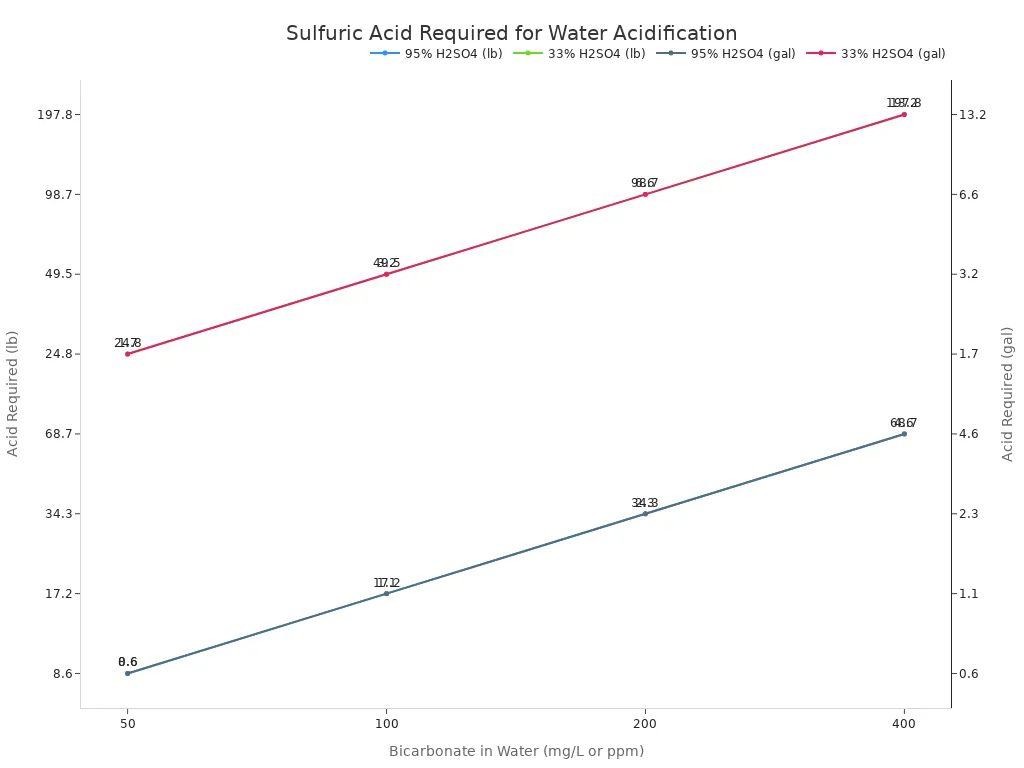
Here is how much sulfuric acid you might need to neutralize bicarbonate in your water:
Bicarbonate in Water (mg/L or ppm) | meq/L | Sulfuric Acid (H2SO4 at 95%) Required per Acre-Inch of Water (lb) | Sulfuric Acid (H2SO4 at 33%) Required per Acre-Inch of Water (lb) | Sulfuric Acid (H2SO4 at 95%) Required per Acre-Inch of Water (gal) | Sulfuric Acid (H2SO4 at 33%) Required per Acre-Inch of Water (gal) |
|---|---|---|---|---|---|
50 | 0.8 | 8.6 | 24.8 | 0.6 | 1.7 |
100 | 1.6 | 17.2 | 49.5 | 1.1 | 3.2 |
200 | 3.3 | 34.3 | 98.7 | 2.3 | 6.6 |
400 | 6.6 | 68.7 | 197.8 | 4.6 | 13.2 |
Note: These amounts neutralize 90% of the bicarbonate. You need more acid to lower the pH to 5.5.
For a few blueberry plants, you can apply acid-water mixtures by hand. Use a watering can. For drip irrigation systems, you can use an EZ-FLO unit. This unit has a tank. You can inject battery acid into the irrigation water. You can set a timer to apply acid regularly. For example, you can apply it daily for 15 minutes during the growing season.
Safety First! Always add acid to water, never water to acid. This prevents dangerous heat and splashing. Keep baking soda or large amounts of water nearby. These can neutralize spills.
The goal for your irrigation water is a pH of 4.5 – 5.5. This range is best for your blueberry plants.
Fertilizing Acid-Loving Plants
Fertilizing your blueberry plants is important. Do this in early spring before leaves appear. Fertilize again in late spring to early summer. Younger plants need more frequent fertilization. This is true during their first two to three years.
Here is a general fertilization schedule:
Plant Age | Fertilization Frequency |
|---|---|
Year of planting | Twice (3-4 weeks after planting, then 4-6 weeks later) |
Second year | Twice (in April, then 4-6 weeks later) |
Third year and older | Once (in spring shortly after buds break) |
Always use fertilizers made for acid-loving plants. These fertilizers help maintain the acidic soil conditions your blueberry plants need. They provide the right nutrients without raising the pH.
Monitoring And Maintaining Soil Acidity
You must regularly monitor your soil’s pH. This ensures your blueberry plants continue to thrive. Maintaining the correct acidic soil environment is an ongoing task.
Regular Soil Testing Schedule
Test your soil pH at least once a year. Do this in the spring before new growth starts. You can also test in the fall after harvest. Consistent testing helps you catch pH changes early. This allows you to make timely adjustments.
Interpreting Test Results
Understanding your soil test results is crucial. An acidic soil pH of 4.5–5.5 is essential for optimal nutrient uptake in your blueberry.
Here is what your pH results mean for your blueberry bushes:
pH between 4.5-5.5: No adjustment is needed. This is the ideal range for your blueberry.
pH between 5.5-6.2: You need soil amendment. Use elemental sulfur. This can take 3-12 months to show results. Re-test and re-apply if needed before planting.
pH of 6.2 or higher: Growing your blueberry in raised beds or containers is best. Use soil media specific for acid-loving plants. It is hard to lower native soil pH this much.
Adjusting Treatments Over Time
Your soil pH can change over time. This happens due to watering, fertilization, and natural processes. If your test results show the pH is rising, apply more acidifying amendments. Use elemental sulfur for a long-term solution. You can also water with acidified water. This helps keep the pH stable. Always re-test after making adjustments. This confirms you reached the target pH.
Recognizing pH Imbalance Signs
Your blueberry plants will show signs if the soil pH is too high. Visual indicators can tell you a lot. Look for stunted growth. You might see small, pale green or yellow leaves. The veins on these leaves often stay green. This is especially true in younger leaves. This can suggest the soil pH is too high for your blueberry.
Other common symptoms include:
Stunted growth
Yellowing leaves
Reduced fruit production
Iron chlorosis (yellowing leaves with green veins, especially in young leaves)
Interveinal chlorosis (yellowing) in young leaves while the veins remain green
These signs mean your blueberry needs attention. Test your soil and adjust the pH.
Maintaining acidic soil is crucial for robust blueberry production. It is the cornerstone of success for your blueberry. You learned about elemental sulfur, peat moss, and acidic mulches for your blueberry. You also learned why to avoid Aluminum Sulfate for your blueberry. Consistent monitoring is necessary for your blueberry bushes. With these practical tips, you can confidently create and maintain the perfect acidic environment for your blueberry bushes. This leads to bountiful blueberry harvests. Enjoy growing your own delicious blueberry fruit.
FAQ
How quickly will my soil become acidic after adding amendments?
The time it takes varies. Elemental sulfur works slowly. It needs 6 to 12 months for bacteria to convert it. Aluminum sulfate acts faster. You can see changes in days or weeks. Always test your soil regularly to track progress.
Can I use household vinegar to make my soil acidic?
You can use vinegar for a temporary fix. It lowers pH immediately. However, the effect does not last long. You would need to apply it constantly. This is not a sustainable or effective long-term solution for your blueberry plants.
What should I do if my native soil pH is very high (e.g., above 7.0)?
It is very difficult to lower a very high soil pH permanently. Consider growing your blueberries in raised beds or containers. Fill these with a specially prepared acidic soil mix. This gives your plants the best chance to thrive.
How often should I reapply acidifying amendments?
You should reapply amendments based on your soil test results. Test your soil annually. If the pH starts to rise, apply more elemental sulfur. This maintains the ideal acidic environment for your blueberry bushes.